
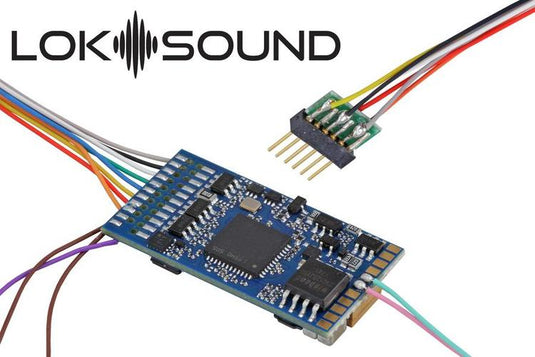
Looking for a compact sound decoder for a 6-pin NEM651 socket?
The LokSound 5 is the most important member of the LokSound family: combining the digital decoder and the sound module on one circuit board achieves very compact dimensions of 30 mm x 15.5 mm, so it fits into almost any H0 or 0 gauge locomotive. This version features a 6-pin NEM651 interface.
Features
- 6-pin NEM651 interface
- Dimensions of 30 mm x 15.5 mm; fits into almost any H0 or 0 gauge locomotive
- Supplied with a sugar cube speaker (11 mm x 15 mm) and a sound enclosure
- True multi-protocol decoder: supports DCC as well as Motorola®, Selectrix® and M4
- 14 through to 128 speed steps, 2- and 4-digit addresses in DCC format and up to 32 functions
- RailComPlus®: decoders register themselves fully automatically on suitable command stations
- Supports all DCC programming modes; with RailCom® and a supporting command station, CV values can be read out on the main; utility registers for command stations limited to CVs 1 to 255
- Motorola®: up to 28 speed steps for 255 addresses, three additional addresses to trigger 16 functions, and an integral programming mode compatible with the Central Unit 6021
- M4 protocol: automatic registration on mfx® compatible central units
- Supports Märklin® braking sections, ZIMO® HLU braking commands and the Lenz® ABC system
- Braking with DCC brake generators or with DC; the locomotive comes to a halt when a Selectrix® braking diode is switched into the circuit
- ABC push-pull feature for automatic commuting between two stations
- Also suitable for analogue DC and AC layouts
- Reproduces up to 10 sound channels simultaneously, each up to 16 Bit / 31250 kHz, for hi-fi sound quality
- Class D audio power amplifier with up to 3W output power, for speakers with a permitted impedance of 4 - 32 Ohms
- Huge 128 MBit sound memory
- Volume of all individual sound fragments may be adjusted separately; outstandingly flexible sound engine without a rigid flow chart
- Three separately adjustable braking functions and two alternative load scenarios
- At least 10 amplified outputs subject to the type of interface; decoders with PluX22 or 21MTC interface have an additional 4 outputs for controlling servos or as logic outputs
- All important lighting functions supported, with the brightness of each output adjustable separately
- Supports the automatic push and pull movements (the coupler waltz) required for digital couplers such as those by ROCO® and Krois® as well as Telex® couplers
- Variable PWM pulse frequency from 10 kHz to 50 kHz for perfectly silent operation, particularly with coreless motors
- Load control adjustable with up to 10 separate CVs and automatic calibration with the unique "Auto Tune" function
- Supplies up to 1.5A motor current, quite sufficient even for older motor types
- Please note that LokSound decoders ship without a preloaded sound file (they are blank)
- If you do not have a LokProgrammer interface, we can load the sound file of your choice onto your decoder at no additional charge
- You have two options: tell us what model of locomotive you have (e.g., EMD SD40-2, MLW M630) and we will select the right file for you, or give us the item number (e.g., S0821) of the sound file you want from the ESU website
- To let us know your choice, add a note in the "Comments" section when entering your payment details at checkout, or send an email referencing your order number to info@modelebt.com
- To listen to the sound samples and choose your file: LokSound sound files for North American and Australian locomotives or LokSound sound files for European locomotives
- You can also purchase an ESU LokProgrammer interface; it is not required for regular programming (address, CVs, etc.) of ESU decoders
- Made by ESU
Description
Looking for a compact sound decoder for a 6-pin NEM651 socket?
The LokSound 5 is the most important member of the LokSound family: combining the digital decoder and the sound module on one circuit board achieves very compact dimensions of 30 mm x 15.5 mm, so it fits into almost any H0 or 0 gauge locomotive. This version features a 6-pin NEM651 interface.
Features
- 6-pin NEM651 interface
- Dimensions of 30 mm x 15.5 mm; fits into almost any H0 or 0 gauge locomotive
- Supplied with a sugar cube speaker (11 mm x 15 mm) and a sound enclosure
- True multi-protocol decoder: supports DCC as well as Motorola®, Selectrix® and M4
- 14 through to 128 speed steps, 2- and 4-digit addresses in DCC format and up to 32 functions
- RailComPlus®: decoders register themselves fully automatically on suitable command stations
- Supports all DCC programming modes; with RailCom® and a supporting command station, CV values can be read out on the main; utility registers for command stations limited to CVs 1 to 255
- Motorola®: up to 28 speed steps for 255 addresses, three additional addresses to trigger 16 functions, and an integral programming mode compatible with the Central Unit 6021
- M4 protocol: automatic registration on mfx® compatible central units
- Supports Märklin® braking sections, ZIMO® HLU braking commands and the Lenz® ABC system
- Braking with DCC brake generators or with DC; the locomotive comes to a halt when a Selectrix® braking diode is switched into the circuit
- ABC push-pull feature for automatic commuting between two stations
- Also suitable for analogue DC and AC layouts
- Reproduces up to 10 sound channels simultaneously, each up to 16 Bit / 31250 kHz, for hi-fi sound quality
- Class D audio power amplifier with up to 3W output power, for speakers with a permitted impedance of 4 - 32 Ohms
- Huge 128 MBit sound memory
- Volume of all individual sound fragments may be adjusted separately; outstandingly flexible sound engine without a rigid flow chart
- Three separately adjustable braking functions and two alternative load scenarios
- At least 10 amplified outputs subject to the type of interface; decoders with PluX22 or 21MTC interface have an additional 4 outputs for controlling servos or as logic outputs
- All important lighting functions supported, with the brightness of each output adjustable separately
- Supports the automatic push and pull movements (the coupler waltz) required for digital couplers such as those by ROCO® and Krois® as well as Telex® couplers
- Variable PWM pulse frequency from 10 kHz to 50 kHz for perfectly silent operation, particularly with coreless motors
- Load control adjustable with up to 10 separate CVs and automatic calibration with the unique "Auto Tune" function
- Supplies up to 1.5A motor current, quite sufficient even for older motor types
- Please note that LokSound decoders ship without a preloaded sound file (they are blank)
- If you do not have a LokProgrammer interface, we can load the sound file of your choice onto your decoder at no additional charge
- You have two options: tell us what model of locomotive you have (e.g., EMD SD40-2, MLW M630) and we will select the right file for you, or give us the item number (e.g., S0821) of the sound file you want from the ESU website
- To let us know your choice, add a note in the "Comments" section when entering your payment details at checkout, or send an email referencing your order number to info@modelebt.com
- To listen to the sound samples and choose your file: LokSound sound files for North American and Australian locomotives or LokSound sound files for European locomotives
- You can also purchase an ESU LokProgrammer interface; it is not required for regular programming (address, CVs, etc.) of ESU decoders
- Made by ESU